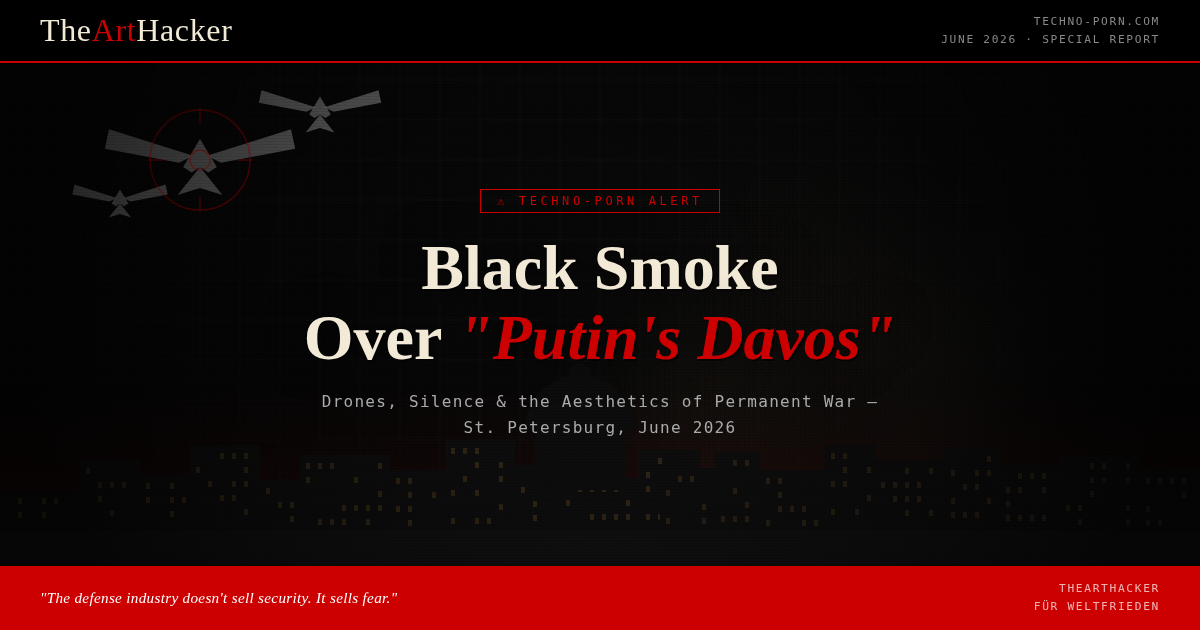
There is a moment — and if you've been paying attention this week, you've seen it — where war stops being war and becomes something else entirely.
It becomes content.
On the morning of June 4th, 2026, the St. Petersburg International Economic Forum opened. Champagne. Lanyards. Keynote speeches about "investment opportunities in a multipolar world." The kind of event where men in suits use the word solutions forty times before lunch.
And above the exhibition hall: a column of black smoke.
Ukrainian drones had struck an oil terminal and a naval hub at Kronstadt — Russia's Baltic Fleet base — just hours before the forum's opening ceremony. The city's airport briefly suspended flights. Mobile internet was cut. Emergency crews scrambled. And inside the glass-and-steel pavilion of what Western journalists have long called "Putin's Davos," organizers quietly instructed staff not to use words that might remind guests of drone strikes.
You cannot make this up.
Welcome to the front line of Techno-Porn.
What Arthur C. Clarke Saw Coming
Arthur C. Clarke coined the phrase "Techno-Porn" to describe a cultural pathology: the systematic aestheticization of military technology. The way we dress up instruments of mass violence in the visual language of desire, innovation, and progress. The way destruction is made to look clean. Inevitable. Even beautiful.
He said it decades ago. He had no idea how far it would go.
Because what happened in St. Petersburg this week wasn't just a military operation. It was a choreographed media event — on both sides.
Ukraine launched 354 drones in a single night across at least 15 Russian regions. A warship struck. An oil terminal ablaze. And not on any random night — but precisely at the moment Russia's most prestigious annual showcase for foreign capital was opening its doors. Zelensky called the strikes "long-range sanctions" — a phrase so carefully chosen it deserves to be studied in media departments, not just military academies.
Not bombs. Not drones. Sanctions. The language of the forum, weaponized against the forum itself.
This is Techno-Porn operating at its most sophisticated: when the weapon doesn't just destroy — it means. When the military operation is also a press release. When the kill chain ends not in a crater but in a headline.
The drone has become the ultimate postmodern weapon: lethal and legible simultaneously. Its footage looks like a video game. Its deployment reads like a marketing campaign. And its victims — on all sides — are rendered invisible by the aesthetics that surround it.
The Forum as Stage Set
Inside the SPIEF pavilion: suits, screens, PowerPoint slides promising returns on investment. Outside: black smoke rising over one of Russia's most historic cities, birthplace of Putin himself. A bank employee who attended — speaking anonymously to the Moscow Times — described it as "the most stifling atmosphere in six years." He said colleagues spent the morning discussing the smoke. "Some people are joking," he said. "But mostly everyone is pretty gloomy because St. Petersburg has never been hit this hard before."
The forum's organizers tried to frame it as business as usual. The war, after all, doesn't appear anywhere in the SPIEF 2026 program. You can attend sessions on "sustainable finance" and "digital transformation" and never once encounter the word missile.
This is Techno-Porn's deepest trick: not the glorification of weapons, but the normalization of their context. The war becomes wallpaper. The smoke becomes atmosphere. And the deals get done.
Among the notable guests this year: Candace Owens, American far-right podcaster. Rodney Mims Cook Jr., US Commission of Fine Arts Chairman, appointed by Donald Trump — the first US official at the forum since 2017. Andrew Tate posted from Moscow.
The aesthetics of war and the aesthetics of celebrity had merged completely.
Putin's Answer: The Performance of Refusal
On June 5th, Putin took the stage at SPIEF for a 45-minute speech followed by two hours of Q&A.
The day before, something remarkable had happened. Zelensky wrote Putin an open letter — the first direct public message from the Ukrainian president to the Russian one since the full-scale invasion began in 2022. He proposed a face-to-face meeting in a neutral country: Switzerland, Turkey, or an Arab state. A full ceasefire during negotiations. Prisoner exchanges. The return of civilians.
Putin's response was a masterclass in theatrical dismissal. He called the letter "boorish." He said he saw "no point" in a meeting. And then, instead of addressing Zelensky at all, he turned to address his army:
"The whole country is looking at you. Keep working, brothers."
This is not diplomacy. This is performance. Designed not for Zelensky, not for the West — but for the Russian public, and for the soldiers in the trenches who needed to hear that their president had no intention of stopping.
The Business Model of Permanent War
The defense industry does not sell security. It sells fear — and then sells you the cure for fear. And right now, business is extraordinary.
Rheinmetall's stock has risen over 1,000% since Russia's full-scale invasion began in 2022. Lockheed Martin, BAE Systems, Leonardo, Thales — all posting record revenues. Every drone that flies is a sales argument. Every rejected peace proposal is another quarter of continued demand.
This is not conspiracy theory. This is basic political economy. Follow the Rüstungsausgaben. Follow the money.
And while the business models are optimized, people die. Ukrainian soldiers. Russian soldiers. Civilians on both sides who never wanted this war and have no say in how it ends.
Why This Matters for Art
I make political art because analysis alone is insufficient. You can write the most precise critique of the military-industrial complex and it will reach the people who already agree with you. But an image — a drone rendered in Apple product-launch aesthetics, a weapons catalogue with "Child casualties: N/A" on the spec sheet — that reaches somewhere else. It bypasses the armor of rationalization.
That's what Techno-Porn critique as art practice is about. Not to aestheticize war ourselves, but to hold a mirror up to those who already do — and ask:
Do you see what you're making beautiful? And do you understand who profits from that beauty?
The black smoke over St. Petersburg has cleared. The forum has ended. The drones will fly again tonight, somewhere. And somewhere, a quarterly earnings call is going very well.
For Weltfrieden. Against the glamour of war.
— TheArthacker